Best Stereo Amplifier With HDMI for Home Theater and Music Enthusiasts
Looking for a stereo amplifier with HDMI that can power your speakers and connect modern devices? This guide highlights five strong options, covering HDMI ARC, Bluetooth and multiple input types. Each pick targets a different listening scenario—home theater, compact setups, or versatile multi-source systems—so you can choose the best fit for your room and gear. The buyer’s table below helps compare essential specs at a glance.
| Product | Power (per channel) | HDMI/ARC | Best For | Limitations |
|---|---|---|---|---|
| Inwa Stereo Amp | 100W @ 4Ω | HDMI (ARC) | 2.0 channel music lovers with TV connections | HDMI is ARC-reliant for audio |
| Yamaha RX300A | 70W | HDMI with ARC/eARC | Balanced home cinema with Atmos potential | 5.2 config over 2 full-height channels |
| Denon AVR-S570BT | 70W | HDMI 2.1, eARC | 8K/4K video fans and hi-fi audio | Higher feature set, larger footprint |
| Pyle PFA540BT | 100W (5 channels) | HDMI | Compact multi-source setup with HDMI video passthrough | Smaller integration for pure home theater |
| Rockville BluAMP 90 | 60W RMS | HDMI ARC | Slim profiles with HDMI ARC for TVs | Lower power vs others |
Inwa Bluetooth Audio Stereo Amplifier

The Inwa model is a compact dual-channel amplifier that outputs 100W per channel under 4 ohms, using the TPA3221 chip for clear, powerful sound. It includes a versatile HDMI (ARC) input along with USB, Optical, Coaxial, and RCA options, plus Bluetooth 5.3 for wireless devices. Best for readers who want a simple, all-in-one amplifier that can power home speakers and also connect to a TV or media player. Choose this if you want strong two-channel audio with an easy HDMI pathway to your TV for synchronized video and audio.
Best for: compact living rooms, media centers, or desks where space is at a premium. The HDMI ARC port helps minimize cable clutter by routing TV audio through the amp. A potential limitation is that this is a two-channel setup, so it won’t deliver true multi-channel surround sound without additional processing or speakers.
Yamaha RX300A 5.2-Channel Receiver

The Yamaha RX300A is a 5.2-channel AV receiver that delivers 70W per channel and supports Dolby Atmos, 4K120/8K60 HDMI, and Bluetooth Multipoint. It’s built for homes seeking immersive audio with flexible speaker configurations, including up-firing or in-ceiling layouts. Best for: users who want a ready-made theater setup with robust video features and easy streaming. Limitation: the 5.2 setup requires careful speaker placement for optimal Atmos effects, and the system’s size may be larger than minimal rooms.
Denon AVR-S570BT 5.2 Channel Receiver

The Denon AVR-S570BT focuses on 8K/4K video support and advanced multi-room features. It delivers 70W per channel with four HDMI 2.1 inputs and eARC, along with HDR support and surround formats like DTS HD Master and Dolby TrueHD. Best for: home theater enthusiasts who want future-proof video capabilities alongside high-quality audio. Better for: users who need strong HDMI bandwidth for gaming and streaming. Caution: a larger footprint and more features may be overkill for simple stereo listening setups.
Pyle Wireless Bluetooth Home Stereo Amplifier
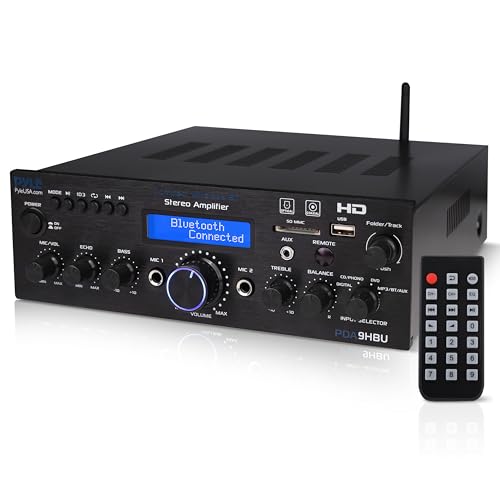
The Pyle PFA540BT is a 5-channel amplifier that handles multiple inputs, including HDMI, Optical/Coaxial, USB, and FM radio. It includes a built-in phono preamp for direct turntable use and supports 4K/3D video passthrough. Best for: users who want a multi-source system with a front panel display for easy navigation. Limitations: as a 5-channel unit, true 5.1 surround may require careful speaker distribution and room setup to avoid audio imbalance.
Donner MAMP6 Stereo Receiver

The Donner MAMP6 provides 1000W peak power across six channels, with Bluetooth 5.3, USB, FM, two mic inputs, and RCA/optical/coaxial options. It’s designed for karaoke and small theater setups, offering a straightforward remote and multi-input flexibility. Best for: home entertainment spaces that require multiple mics and easy control. Caution: peak power specs can be misleading if actual continuous output is a priority; intended for short bursts rather than prolonged loud use.
Pyle 100W 5 Channel PFA540BT

The Pyle PFA540BT focuses on 5-channel surround capabilities with HDMI input and output for 4K/3D passthrough. It includes Bluetooth, USB/SD, and a front-panel interface for quick adjustments. Best for: compact rooms needing a multi-source amplifier with video passthrough. Consideration: the product’s design emphasizes feature breadth, which can complicate setup for purely stereo listening in very small spaces.
Sony STR-DH590 5.2 Channel Receiver

The Sony STR-DH590 provides 5.2 channel surround with dual Bluetooth options and 4K HDR pass-through. It supports virtual surround features and is designed to deliver cinematic sound with a relatively straightforward setup. Best for: users seeking a reliable Sony option with room-filling audio and simple HDMI connectivity. Limitation: features like virtual surround may not equal the depth of a larger, dedicated multi-speaker system.
Buying Guide: Key Purchase Considerations
What to prioritize when choosing a stereo amplifier with HDMI?
- Output Power and Impedance: Match the amp’s wattage to your speaker’s power rating (typically 4-8 ohms). Higher wattage supports louder playback with less distortion.
- HDMI and Video Features: Look for HDMI ARC/eARC support, HDR compatibility, and 4K/8K video passthrough if you plan to route video through the receiver.
- Input Versatility: Assess the variety of inputs (HDMI, Optical, Coaxial, USB, Bluetooth, Phono) you actually use. More inputs reduce the need for extra adapters.
- Multi-Channel vs. Stereo: Decide whether you want true 5.1/7.1 surround or a robust two-channel system. Some AMPs offer multi-channel configurations, while others optimize stereo output.
- Room and Setup: Consider the footprint and placement flexibility. Receivers with smaller chassis may suit compact rooms, while larger units fit dedicated home theaters.
- Source Reliability and Ease of Use: Front-panel controls and remote usability can affect how quickly you switch between sources during viewing or listening sessions.
FAQ
- Do I need HDMI on a stereo amplifier? Yes, if you want to feed audio from a TV or Blu-ray player through the amp, especially when using HDMI ARC.
- Is 70W per channel enough for a small living room? For typical 2.0 or 2.1 setups with efficient speakers, yes. Larger rooms may benefit from higher wattage or a dedicated subwoofer.
- Can I use a stereo amp with a turntable? Some models include a built-in phono preamp; otherwise, you’ll need a separate preamp or an amplifier with a dedicated phono input.
- What does ARC mean in HDMI? Audio Return Channel lets your TV send audio back to the amplifier over the same HDMI cable, simplifying connections.
- Should I prefer a dedicated AV receiver or a stereo amp with HDMI? If you want multi-channel surround sound with extensive video processing, a full AV receiver is typically better; for pure two-channel audio and TV passthrough, a stereo amp with HDMI ARC can be sufficient.
- Are Bluetooth-enabled amplifiers secure? Bluetooth ranges vary, but modern devices use stronger, stable connections. Place the receiver within direct line of sight of your primary devices for best performance.
These options cover a spectrum from compact two-channel systems to full-featured multi-channel receivers. Each choice offers HDMI connectivity, making it easier to integrate with modern televisions and media players while delivering solid stereo or multi-channel performance tailored to different room sizes and listening goals.