Best 4-Channel DI Box Solutions for Stage and Studio
Direct injection (DI) boxes are essential for clean, balanced, and noise-free signal transmission. This guide highlights five solid 4-channel DI box options, covering passive and active designs for stage rigs, live venues, and studio work. Each pick is evaluated for reliability, ease of use, and signal integrity. The top picks are best for guitarists, keyboardists, and multi-instrument setups seeking independent channel control, ground lift features, and versatile output configurations. Use the quick reference table below to compare core capabilities at a glance.
| Product | Type | Channels | Best For |
|---|---|---|---|
| ART PDB4 Four Channel Passive Direct Box | Passive | 4 | Guitarists and keyboard players needing fully isolated channels |
| dbx DI4 Active 4-Channel Direct Box with Line Mixer | Active | 4 | Studio and live sound with independent padding per channel |
| Radial 4-Play 4-Channel Output, Instrument Direct Box | Active | 4 | Musicians needing single-box multi-output with controls |
| Behringer ULTRA-DI PRO DI4800A | Active | 4 | Budget-friendly pro setups with multiple XLR outputs |
| SONICAKE Junction Box – Passive 4 Channels TRS Stereo | Passive | 4 | Compact pedalboard or routing setups with TRS needs |
ART PDB4 Four Channel Passive Direct Box

The ART PDB4 provides four fully isolated channels in a compact passive design. Each input supports passive operation with switchable input attenuation (0dB, -20dB, -40dB), helping manage hot instrument signals before conversion. This model suits players who prefer a simple, battery-free setup with predictable, transparent signal flow. Best for players who want isolation across all channels without the need for power or active buffering.
Best for: multi-instrument rigs where simplicity, reliability, and consistent impedance are priorities. It is a good choice for guitarists and keyboard players who need clean DI without extra noise or hum. Caution: as a passive box, it relies on balanced sources and suitable gain staging to avoid level loss in long cable runs.
dbx DI4 Active 4-Channel Direct Box with Line Mixer

The dbx DI4 is an active 4-channel DI with independent 20dB pad control per channel and per-channel ground lift. This configuration helps manage hot sources, reduce noise, and eliminate hum from ground loops. With an integrated line mixer approach in a compact 1/2 RU footprint, it suits small to medium live rigs and studio setups where multiple signals must stay clean and individually controllable. Best for: systems needing per-channel gain control, padding, and ground lift without external processing gear.
Limitation: as an active DI, it requires power; ensure your stage or rack power is stable to avoid noise floor fluctuations. Choose this when per-channel padding and ground isolation are critical for your mix.
Bolanle DI8000 Pro 8-Channel Direct Active Box

The Bolanle DI8000 Pro offers eight active DI channels in a single unit, reconfigurable for large multi-instrument setups. Each channel provides its own input and balanced XLR outputs, along with individual PAD and ground lift options. This makes it ideal for complex stage or studio environments needing flexible routing across many devices without a rack of separate DI boxes. Best for: multi-instrument stages or studios that require scalable DI capacity with precise per-channel controls.
Caution: eight channels increase the unit’s footprint; verify rack or desk space and power availability in your setup. This model excels when you need one box to cover many signals with independent controls.
Radial 4-Play 4-Channel Output, Instrument Direct Box

The Radial 4-Play offers one channel of active DI with four balanced outputs, along with an Output Select switch and a Mute switch. It is designed for players who need a robust, road-ready DI with quick routing options for stage or studio setups. Best for: performers who require a single-channel DI with multiple, independent outputs for a compact live or recording rig. Limitation: it is a single-channel DI with four outputs, so it may not provide four completely independent channels like other multi-channel DI boxes.
Choosing this: use when you primarily route one instrument to multiple destinations (PA, direct feed, and monitor) with fast on-stage control.
Behringer ULTRA-DI PRO DI4800A 4-Channel
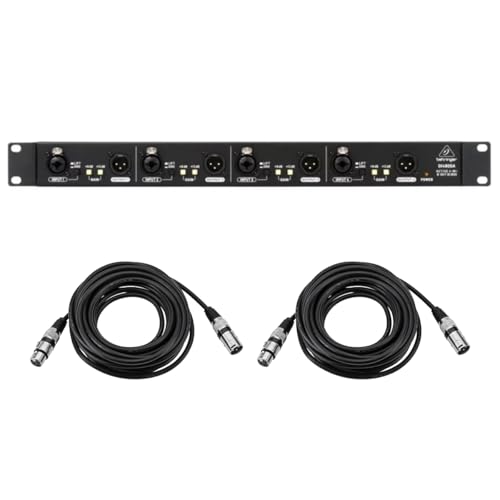
The Behringer ULTRA-DI PRO DI4800A bundles a 4-channel active DI box with a DC power supply and a 1-year limited Adorama warranty. It features 4 XLR-1/4″ combo inputs and eight transformer-balanced XLR outputs, delivering flexible connectivity and a wide frequency response. Best for: budget-conscious venues or studios requiring solid, reliable DI performance across four channels with generous output options. Caution: Behringer pricing often reflects value; ensure the unit’s cabling and rack footprint fit your setup.
ART DualZDirect Dual Passive Direct Box

The ART DualZDirect is a fully passive Direct Box featuring a high-performance transformer and 50k-ohm to 600-ohm balanced outputs. It provides switchable input attenuation (0, -20, -40 dB) and a switchable low-pass filter, extending its versatility to instrument and line-level signals. Best for: users who want a compact, battery-free DI option with clean, dependable signal conversion. Limitation: not a true 4-channel unit; it’s a dual-channel DI with two outputs, so this selection is included for readers evaluating alternative passive options in a multi-BOX setup.
SONICAKE Junction Box – Passive 4 Channels

The SONICAKE Junction Box provides four passive channels with TRS stereo connections, enabling multiple routing options and a tidy pedalboard layout. It is suitable for line extension, organizing signals, and optimizing effect chains. Best for: pedalboard users or small studios needing a straightforward, passive multi-channel DI solution with TRS convenience. Caution: as a passive device, it relies on connected sources and proper gain staging to maintain signal levels across outputs.
Buying Guide: Key Purchase Considerations
Direct boxes come in passive and active flavors. Passive DI boxes preserve tone with transformer isolation but require suitable source impedance and gain, while active DI boxes provide higher headroom and can buffer long cable runs. Consider the following when choosing a 4-channel DI box system:
- Channel independence: Do you need four fully independent outputs or multiple outputs from a single instrument?
- Power needs: Active DI boxes require power; ensure power availability on stage or in your studio rack.
- Input/output options: Look for XLR, 1/4″ TRS, and combo jacks to fit your gear and future needs.
- Padding and gain: Per-channel pad controls help manage hot guitar/pedalboard signals and prevent clipping.
- Ground lift: Ground lift switches reduce hum from ground loops in live environments.
- Portability and form factor: Consider rackmount, 1/2 RU, or pedalboard-friendly designs depending on your setup.
- Signal integrity: Prioritize units with transformer isolation and balanced outputs for noise rejection.
- Budget vs. features: More channels and active buffering add cost; balance needs with your rig’s complexity.
Frequently Asked Questions
- What is the main difference between passive and active DI boxes?
- How many channels should my DI box have for a typical small live setup?
- Do DI boxes affect tone significantly?
- Is it better to use one multi-channel DI or several single-channel boxes?
- Can DI boxes help with long cable runs?
- Are there any safety considerations when using DI boxes on stage?
In summary, the ART PDB4, dbx DI4, Radial 4-Play, Behringer DI4800A, and SONICAKE Junction Box each offer distinct advantages for 4-channel DI needs. Whether you prioritize isolation, padding, ground lift, or compact routing, these choices cover a range of performance levels and budgets. Use the buying guide to align features with your exact setup and performance goals.