Best Four Zone Speaker Selector With Volume Control for Home Audio
Choosing the right four-zone speaker selector with built-in volume control is essential for a clean, scalable home audio system. The models below provide independent volume controls for each zone, plus protection features that guard amplifiers when multiple speaker pairs operate from a single source. They are suitable for home theaters, multi-room listening, and outdoor spaces. This guide highlights five reliable options with solid build quality, impedance protection, and straightforward wiring. Readers will find practical notes on installation, compatibility, and how these units compare on power handling and feature sets.
| Product | Brand | Channels | Key Feature |
|---|---|---|---|
| Monoprice 4-Channel SSVC-4.1 | Monoprice | 4 | Impedance protection and independent zone controls |
| Pyle PSLSW4 | Pyle | 4 | Independent volume controls per zone with easy screw-terminals |
| Pyle PSLSW4.5 | Pyle | 4 | Compact design with independent zone volume control |
| Pyle PLSHVC412 | Pyle | 4 | 4 x 100W max per channel with per-zone volume |
| OSD RSVC4 | OSD Audio | 4 | Volume control per zone with amplifier protection |
Monoprice 4-Channel Speaker Selector With Volume
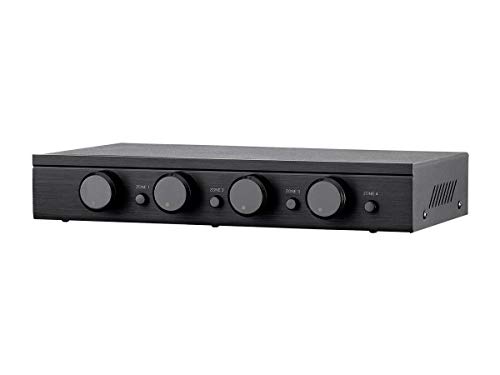
Monoprice’s SSVC-4.1 delivers four independent zones from a single amplifier. It includes automatic impedance protection to guard amplifiers when multiple speaker pairs are active. Each zone has its own volume control and an on/off switch, simplifying multi-room listening without cross-talk. The unit supports up to 100 watts per channel continuously (200 watts peak) and specifies impedance minimums that help prevent strain on the amplifier when driving several speakers. This model is well-suited for integrated home theater or distributed audio setups where safety and clarity matter.
- Automatic impedance protection circuitry protects the amplifier during multi-zone operation
- 100 watts per channel continuous power, 200 watts peak
- Four zones with individual on/off and volume controls
- Minimum amplifier impedance: 5 ohms with four 4-ohm speakers; 6 ohms with eight-ohm speakers
- Single-input distribution to four speaker pairs
Pyle 4 Channel Speaker Selector Switch
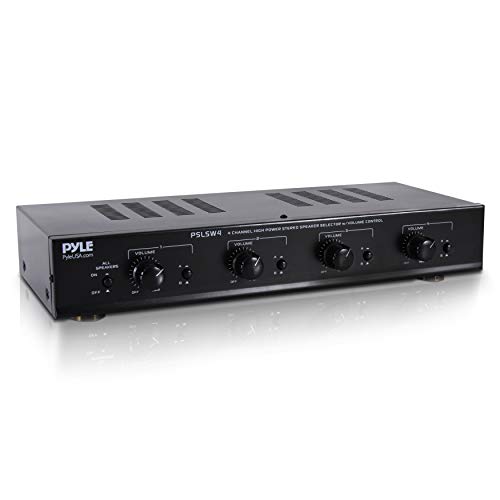
The Pyle PSLSW4 is designed for distributing sound to up to four speaker pairs from a single stereo amplifier. It supports 8-ohm impedance speakers and handles up to 100 watts per channel, making it suitable for typical home theater or stereo configurations. Independent volume controls let each zone be adjusted without impacting others. The unit uses screw-terminal connections (14 AWG rated) for durable wiring and a compact tabletop form factor that fits neatly into most entertainment setups.
- 100 W per channel max power, 8-ohm compatible
- Controls up to four speaker pairs from one amplifier
- Independent volume controls per zone
- Screw-type terminals for easy wiring; accepts up to 14 AWG wire
- Compact, table-top design for convenient placement
Pyle 4 Channel Speaker Selector Switch 4.5
The Pyle PSLSW4.5 provides four-channel distribution with a compact footprint. It supports up to four speaker pairs and up to 100W per channel, ensuring solid performance for home theaters and multi-room audio. Independent volume controls per channel enable tailored listening across zones, while its efficient design keeps installation unobtrusive. This model is well-suited for users who want a balance of space efficiency and zone-specific control without extra bulk.
- Supports four speaker pairs; 100W per channel
- 8-ohm impedance compatibility for reliable performance
- Independent volume controls for each channel
- Compact, space-saving design suitable for home theaters
Pyle Premium 6 Zone Speaker Switch (4-Zone Variant)
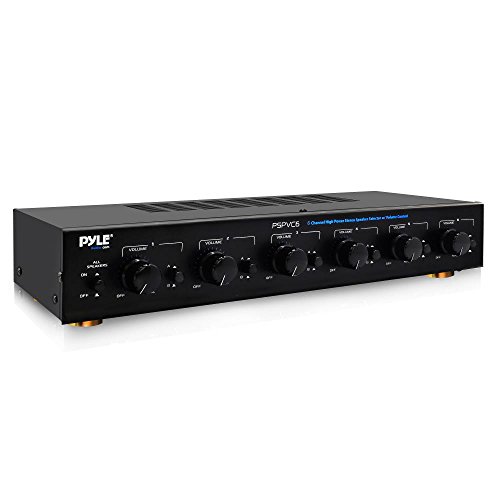
Note: This entry references a Pyle product that includes multiple zone configurations; for four-zone needs, the PLSHVC412 or PSLSW4 family offers a more compact solution. The PSPVC6 offers robust multi-zone distribution for larger setups and demonstrates Pyle’s broader approach to speaker switching. When selecting a model, consider whether you need exactly four zones or optional expansion to additional zones, and verify per-channel power delivery and impedance compatibility for your amplifier and speakers.
- 4 x 100W per channel in compact 4-channel variants
- Supports multiple speaker pairs with zone-specific control
- Rugged housing options in Pyle’s line for durability
OSD Audio 4X Speaker Selector With Volume

OSD Audio’s RSVC4 offers four zones with built-in volume control per zone and is positioned as a reliable, affordably priced solution for distributed audio. The device is designed to protect amplifiers by being compatible with low-ohm amplifiers rated at 2 x 80 W RMS, which helps prevent amplifier stress when multiple zones are active. It also emphasizes clean channel separation and straightforward wiring, making it a practical option for entry to mid-level multi-room installations.
- Controls four speaker pairs or zones
- Includes independent volume control knobs for each zone
- Amplifier protection through compatibility with lower impedance amplifiers (2 x 80 W RMS)
Buying Guide
When selecting a four-zone speaker selector with volume control, you should balance performance, compatibility, and installation practicality. The following considerations help clarify the best choice for different home setups:
Channel count and zone independence: Ensure the model truly supports four distinct zones with independent volume controls. Some designs offer shared volume or fewer control options, which can limit customization across rooms or spaces.
Power handling and impedance: Check the per-channel wattage and the minimum amplifier impedance required when all zones are active. Higher wattage provides headroom for demanding speakers or larger rooms, while proper impedance protection safeguards amplifiers from overloading when multiple speakers are driven simultaneously.
Wiring and connections: Look for straightforward wiring, such as screw terminals that accommodate common speaker wire gauges (6 to 14 AWG). Clear labeling for input and outputs reduces installation time and errors in complex setups.
Build quality and heat management: A robust chassis, solid connectors, and solid heat dissipation improve long-term reliability, especially in configurations with compact layouts or enclosed cabinets where heat can build up.
Form factor and placement: Decide whether a tabletop, rack-mount, or in-wall design best fits your space. A compact footprint is advantageous for smaller rooms, while a larger unit may simplify cabling in bigger home theaters.
Sound identity and balance: Some units offer stricter impedance protection, which can influence tonal balance when multiple zones are active. Consider whether the unit maintains consistent output across all zones or if minor variations are acceptable in your layout.
Budget versus features: Higher-end models often provide tighter tolerances for impedance, more precise volume control, and stronger build quality. For many households, a mid-range option with reliable protection and clear per-zone control delivers the best value.
Practical deployment notes: For homes with long cable runs or multi-room networks, plan your wiring path to minimize cross-talk and interference. Label each run clearly and test each zone with the amplifier at a modest level before finalizing the setup. If you plan to expand beyond four zones in the future, verify whether the selector supports additional outputs or if you’ll need to add an external distribution amp.