Best 12V Car USB Charger Picks for Safe on-the-Go Power
Looking for a reliable 12V car USB charger? This guide highlights top options that balance fast charging, safety, and dashboard tidiness. Best for daily commuters, road-trippers, and tech-heavy travelers who need multiple devices charged simultaneously.
The table below compares five strong picks, helping you choose the right mix of ports, power, and price.
| Product | Ports & Power | Best For | Notable Point |
|---|---|---|---|
| LISEN Car Charger USB C, 69W | 2 Ports (USB-C 36W, USB-A 18W) | Charge two devices quickly on the go | Balanced power distribution reduces heat |
| JUNVANG USB C Car Charger, 90W | 4 Ports (2 USB-C, 2 USB-A) | Multiple devices at once | High total output with PD/QC support |
| Anker 323 52.5W USB C Car Charger | 2 Ports (USB-C 30W, USB-A 22.5W) | Compact and fast dual charging | PowerIQ 3.0 compatibility |
| KENHAO USB C Car Charger, 67W | 3 Ports (2 USB-C, 1 USB-A) | Flexible charging for USB-C devices | Metal housing for heat dissipation |
| power-7 USB-C Car Charger, 70W | 3 Ports (1 USB-C 40W, 2 USB-A 30W total) | Triple-port convenience | Smart chip for safety and efficiency |
LISEN Car Charger USB C, 69W Dual Port
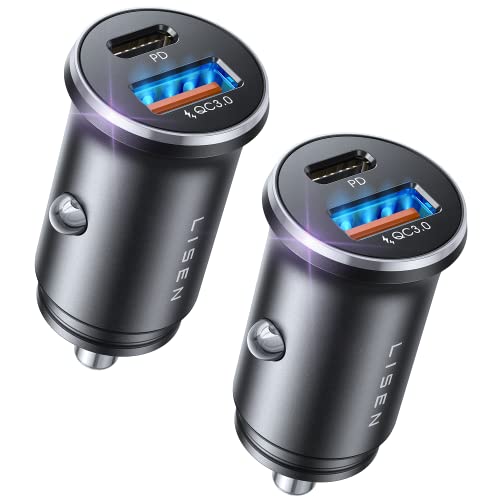
Features include a 36W PD USB-C port and a 18W USB-A port. The design emphasizes reduced heat and clutter by avoiding a single overloaded outlet. The USB-C port is ideal for iPhone 17/16/15/14/13/12 series, while the USB-A port covers many Android devices and tablets. Best for drivers who need reliable, balanced charging for two devices without dashboard chaos.
Who should use it: daily drivers with one or two devices needing fast charging, and mobile professionals seeking cleaner cab interiors. Limitation: lacks more than two ports, so heavier multi-device setups require additional adapters or a higher-port model.
JUNVANG USB C Car Charger, 4-Port 90W

This 4-port charger delivers up to 90W total with two USB-C outputs and two USB-A outputs. It supports PD/QC fast charging and is suitable for iPhone 17/16/15/14/13/12 series, iPad, Samsung Galaxy lines, and many Android devices. Best for households or families with multiple devices needing simultaneous high-speed charging. Limitation: higher price and bulkier than dual-port options.
Anker 323 52.5W USB C Car Charger

Two ports provide 30W (USB-C) and 22.5W (USB-A) of fast charging. Its PowerIQ 3.0 technology supports broad compatibility across iPhone, Samsung, Android tablets, and more. Best for users who want straightforward, reliable dual-port fast charging in a compact form. Caution: does not support Qualcomm Quick Charge on the USB-C port in some scenarios; check device compatibility if you rely on QC for rapid top-ups.
KENHAO USB C Car Charger, 3-Port 67W

Supports PD 37W (USB-C) and QC 30W (USB-A) with three ports to charge multiple devices at high speed. All-metal housing improves heat dissipation, and it claims robust protection against over-current, over-voltage, and overheating. Best for travelers who need versatile USB-C and USB-A support in one unit. Limitation: some users may prefer more USB-C power if charging two PD devices simultaneously.
power-7 USB C Car Charger, 2 Pack 70W

Triple-port design with one USB-C port delivering up to 40W and two USB-A ports sharing the remainder. The 70W total output supports fast charging for iPhone and Samsung devices. Best for road trips where multiple devices must be charged at once. Limitation: USB-C power is split with USB-A, so heavy PD usage on multiple devices may reduce USB-C performance.
Buying Guide
Key factors to consider when choosing a 12V car USB charger
- Power output and ports: Decide how many devices you need to charge and how fast. Look for PD (Power Delivery) and QC (Quick Charge) support for faster USB-C and USB-A charging.
- Port distribution: If you use several devices, a 4-port or 3-port model may be preferable to keep cable clutter down and prevent overloading a single port.
- Heat management: Chargers with better heat dissipation and balanced power distribution tend to run cooler and safer during long drives.
- Device compatibility: Ensure the charger supports your phone, tablet, or laptop model, especially if you rely on PD for high-wattage devices.
- Build quality: A metal housing generally offers better heat dissipation and durability than plastic.
- Size and dashboard fit: Compact shapes save space on crowded consoles and avoid blocking access to other controls.
- Safety features: Look for protection against over-voltage, over-current, short-circuit, and overheating for safer on-the-road charging.
Frequently Asked Questions
- What does PD mean in car chargers?
PD stands for Power Delivery, a fast-charging standard for USB-C devices that can deliver higher wattage than standard USB charging.
- Is a higher wattage charger always better?
More watts help charge faster, but your device must support the same wattage to gain the benefit. Excess wattage with a device that can’t accept it won’t speed up charging.
- Should I choose a 2-port or multi-port charger?
Two-port chargers are compact and often adequate for most households. Multi-port units save space when charging several devices at once, but ensure heat is managed well.
- Are metal-bodied car chargers safer?
Metal housings typically improve heat dissipation and durability, contributing to safer operation under load.
- Can car chargers charge laptops?
Some high-wattage USB-C car chargers can, if they provide enough power and device supports Power Delivery; check device wattage limits first.